Sometimes the hardest part of a creative journey is the beginning.

Getting the pen to paper can be a daunting task, no matter what venture it is. Even with my thesis, the ideas have been swirling around for a long time, and of course doubt finds ways to creep in no matter what. "Is it a good idea?" "Does it meet any scholarly requirements?" "Could I even successfully execute something like this?"

The answer to all these questions is yes, and then eventually even more questions. Sometimes you don't even need an answer. There are of course many ways to help mitigate doubt in the creative process. Reading others experiences, writing down any thoughts good or bad, rubber-ducking with a mentor, or an actual rubber duck.

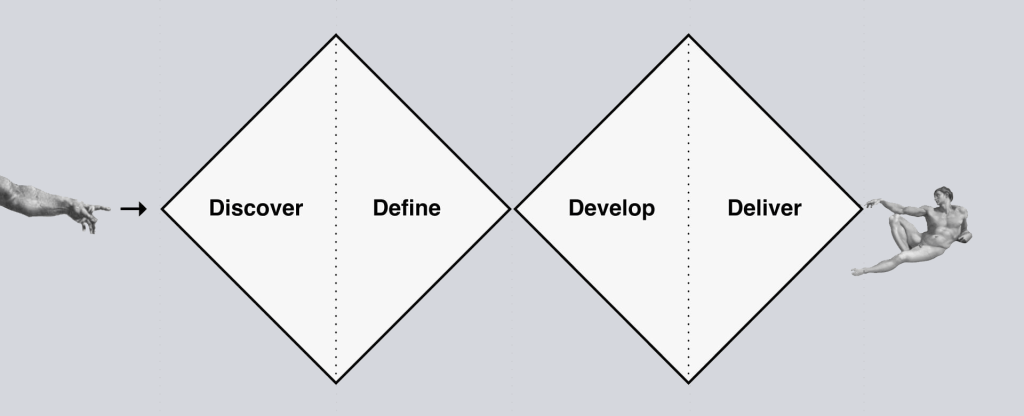
Personally, I like to temper my expectations, but leave room for wild ideas and practicing the dark arts. It's a fine line between a "go with the flow" and "shoot for the moon" mentality versus being realistic about personal ability, time management, and hardware/technological limitations. My mentor and major professor for my thesis introduced me to the double diamond methodology of practice. The funnel starts wide, exploring any possibilities, eventually closing in until you find a unifying point that brings it all together. Then the funnel opens up again, going from that point into more possibilities, until it closes yet again as a complete work.
In terms of actually starting my thesis, I've already done a couple things set-up wise before making this website. I started with downloading StreamDiffusion and TouchDiffusion, TouchDesigner widgets that integrate Stable Diffusion (I already have had TD for a while), AutoLume, an AI model research tool with live visual functionality, and Cables.GL, another node-based coding tool that functions similarly to TouchDesigner, but offers increased web functionality.
Of course, I have used TouchDesigner frequently in the past for performance and web visuals with and for some artists, you can find some examples of this work on my portfolio.
In terms of my thesis, I will be using these tools to explore the role these AI tools can have in live performance and installation settings, paying particular attention to different areas of interaction between a human and an AI model. As AI is still in its infancy, there may be even more tools that come up in the next year or two that can help or add to this project, which I am extremely excited to see what people make.
If you're reading this, I want to extend my thanks for taking the time to check in on my progress. Hopefully you'll stick around for what will come in the future!
Ryan Schlesinger is a multidisciplinary designer, artist, and researcher.
His skills and experience include, but are not limited to: graphic design, human-computer interaction, creative direction, motion design, videography, video-jockeying, UI/UX, branding, and marketing, DJ-ing and sound design.
This blog serves as a means of documenting his master’s thesis to the world. The thesis is an exploration of AI tools in the space of live performance and installation settings.

 un-prompted