This week being the first progress report, I'll mainly cover my presentation content, what I learned from it, and how I can move forward in the best way. I'll also cover some readings I covered this week in other classes that can relate to my thesis in one way or another.
What I’ve Made
Reflecting on the presentation and how it went, I wouldn't say it went the best, or was really up to my personal standards. I've certainly done better presentations in the past, but it was valuable in understanding where I'm at in regards to the development of my thesis. In taking a couple days to organize my thoughts, it is apparent that I need to narrow down much more the topic and I what I am really trying to accomplish, which is why I feel I was so disorganized in communicating my thoughts. I certainly have ideas for interesting projects that incorporate AI in non-traditional ways that change the mode of interaction, but putting them all together in a meaningful way is certainly a necessity and a lacking part of where I am currently at. This was reflected in the feedback from the audience as well, with good considerations and questions for me to think about on how to make the body of work more accessible and understandable for a broader audience.

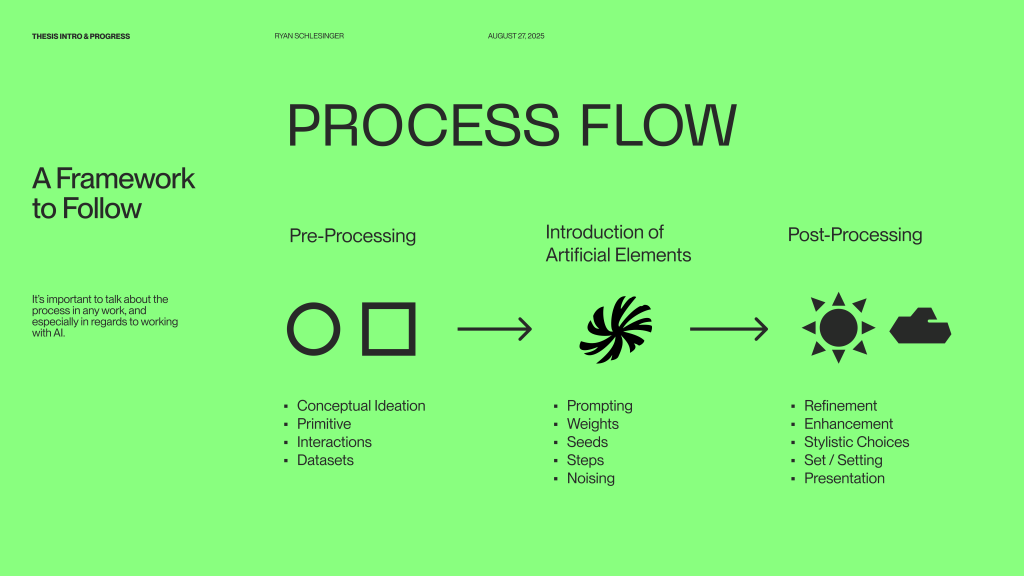
There were some good things, however. The process framework is a valuable asset to have in the time to come for the development of some of the bigger ideas I need to have. Putting a process down like this is a good way to organize thoughts on a project level, and a source of organization/deliberation to come back to as things progress. As with most other aspects of my thesis at this point it will need refinement in its presentation and applicability. It is also a source of accessibility too. If I were to conduct a workshop that goes through a creative workflow with AI, even a high-level process like this could open new ideas and avenues for exploration from participants.
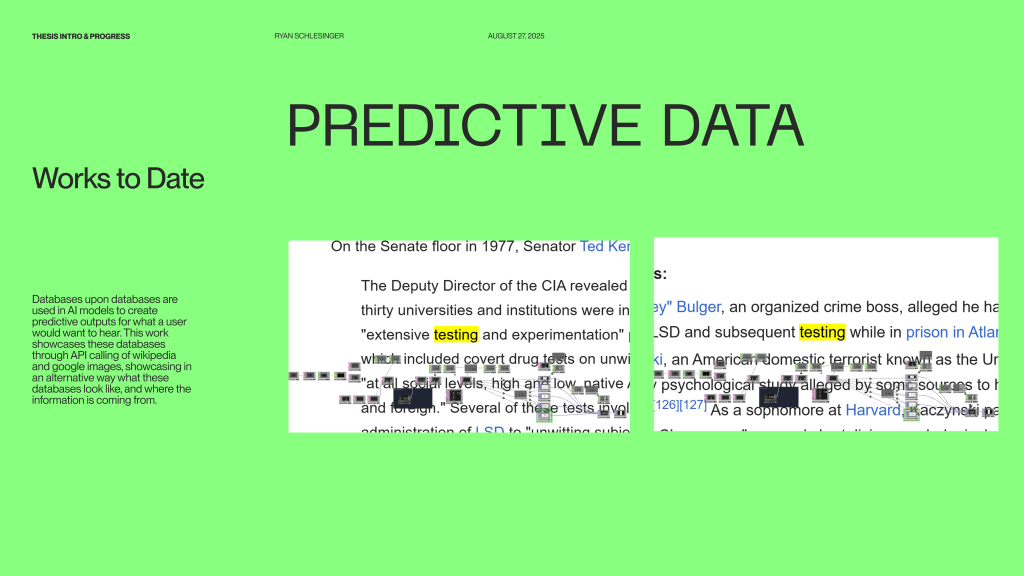
Lastly, even if conceptually I still have a lot to work towards, the project ideas I mentioned do exist and remain an actionable component I can work on. For example, something I can immediately work on from the presentation I briefly talked about is this system I made in Touch Designer that pulls from Wikipedia's API in order to visualize in some way the insurmountable data that AI models pull from all corners of the internet. My initial idea to expand on it is to create a database of words separated by their type of speech / sentence structure (i.e. separated by noun, verbs, adjectives, etc.), then have a text to speech model randomly ping out words in a common sentence structure. The goal in something like this is to visualize the process of an AI deliberating on how to come up with a sentence in a typical chat interface, and how this can lead to hallucinations or misinformation. The "sentences" it makes are structured right and contain the right words, but the context is absent and construed, and the meaning is obscured or non-existent from a human angle.
What I’ve Read
This week I've had the chance in some of my other classes to read on AI in a couple different areas, one paper in particular on how AI is changing the creative process with some examples or artists using it in unique and alternative ways, and criticism and pitfalls with including it in the creative process.

The article, titled “AI to Supercharge Creativity”, situates generative AI not as a replacement for human artistry but as a potential collaborator that reshapes how creativity unfolds. Featured artist Lizzie Wilson demonstrates this through live coding performances, where an AI “agent” injects unexpected loops and rhythms into improvised live-coded music, pushing her beyond habitual choices. Her approach touches on points of co-creativity I wish to cover in some facet in my theses, in which AI acts less as a producer of polished outputs and more as a partner that surprises, provokes, and challenges human thinking. These interactions shift the focus of creativity away from automation and toward augmentation, and a dialogue between human intention and machine suggestion.

Those interviewed in the article emphasize that creativity requires friction, reflection, and even failure. Mike Cook notes that removing failure from the process, as frictionless generative tools often do, undermines the very struggles that cultivate artistic growth. Similarly, Jeba Rezwana critiques the “one-shot” interaction of systems like Midjourney or DALL·E, which automate creation but limit back-and-forth iteration. This concern reframes AI not as a means of efficiency but as a medium that should slow us down, forcing reconsideration and experimentation. Elisa Giaccardi echoes this by asking whether true creativity can exist without material that “pushes back,” underscoring the importance of resistance and surprise in the creative process. In the case of Lizzie Wilsons live coding performances, the AI doesn't make the music for her, but introduces new rhythms that can be supplanted into her performance. "Sometimes it goes wrong, and that’s just part of the creative process." - Lizzie Wilson

Ultimately, what I gleamed from the article is that the future of AI in creative practice depends less on making outputs “better” and more on making processes richer. The tension between control and surprise remains unresolved: commercial tools offer accessibility but little agency, while research prototypes provide depth at the cost of usability. The most promising direction as far as creativity lies in viewing AI not merely as a tool but as a material. It's something to be misused, bent, and challenged, just as artists have always done with paint, clay, or sound. In the development of my thesis, this reveals an importance of designing AI systems that expose bias, embrace failure, and provoke reflection, reframing creativity with AI as a dialogue that reaffirms human agency, where the AI can have a helping hand in shaping the outcome, not the other way around.
Where the Next Steps are Leading
My next steps from this point based on the presentation and reading are again to further pursue the conceptual development of my thesis, really narrowing down what I want to say and how I can say it. As far as class activity, I think the flow chart we will be making can help in this pursuit, where to divy time between project based work and conception based work. I have projects such as the wikipedia api network that I will hope to achieve a more in-depth version in the next 1-2 weeks, but my main goal is to read many more research articles and past thesis' that can help in this organization and narrowing down of ideas. What has been said already, what can be said now? On the horizon in the next month would be to develop a workshop process that emphasizes accessibility using the process flow I've made, but the overall goal stands to reposition and narrow down the subject matter, keeping in mind accessibility and messaging, and how that can be supported by projects I've made, prototypes I will make, theories, and process documentation.
Bibliography
Heaven, W. D. (2025, May/June). AI to supercharge creativity. MIT Technology Review. https://www.technologyreview.com/
//about
Ryan Schlesinger is a multidisciplinary designer, artist, and researcher.
His skills and experience include, but are not limited to: graphic design, human-computer interaction, creative direction, motion design, videography, video-jockeying, UI/UX, branding, and marketing, DJ-ing and sound design.
This blog serves as a means of documenting his master’s thesis to the world. The thesis is an exploration of AI tools in the space of live performance and installation settings.


 un-prompted