For this week in progress report one of the main things I made is my timeline for what [I think] my process will look like. I'll cover that, along with a reading and one thing based on that reading I will explore on making over the weekend/next week, with a plan to show some progress on how it turns out next week.
The timeline
A major thing I made this week was my timeline. While, of course, there are still refinements to be made, this was a really good exercise in terms of dumping everything I could think of doing based on where I'm at; out in one place, instead of holding it all in my brain. We talked on Tuesday about writing to write and get thoughts out, and this served a similar purpose to reduce the cognitive load of timelines and things. If I were to present this to my committee, I would clean up the weekly area a bit more, and structure it out similar to how Silvia did hers, divvying it up by the type of task. It also could be beneficial to make an Asana board like Carly did too, the idea behind that being Asana could serve as a more structured overview of timeline and progress, while the Figjam could be this living document I continuously come back to. A sort of messy hub as a source of truth for all things thesis related, which is something the inclusion of the funnel supports as well.
Being still in the scoping stages I haven't quite yet made any sort of thing yet besides the timeline, presentation, and the preliminary explorations I presented in the presentation. However, going off this I have made strides and plans for what is to come next, however far away it might be. For instance, I've looked into the IRB exemption forms, which I believe my areas of research should fit nicely into, and have begun filling them out paired with sending inquiry emails to the IRB ISU people just to make sure. Pending their return emails at the time of writing, and some more reading / exploration of workshops as a research method, I will hopefully be submitting the form within the next two weeks.
Readings
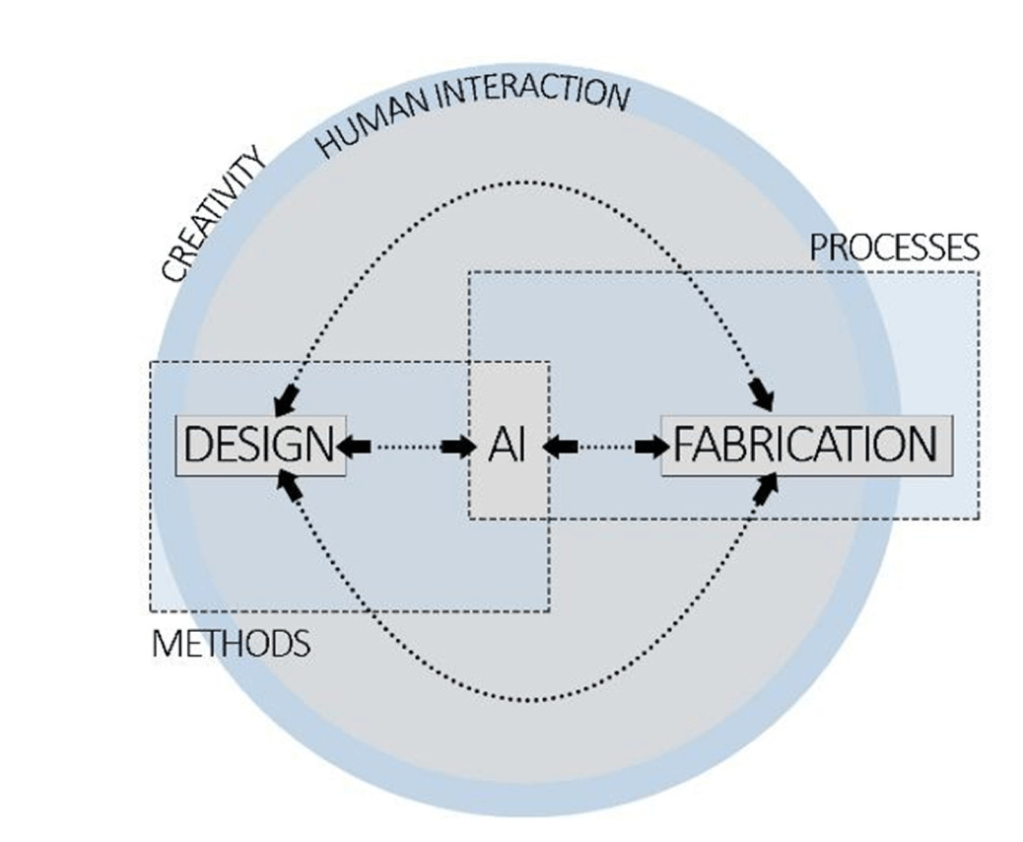
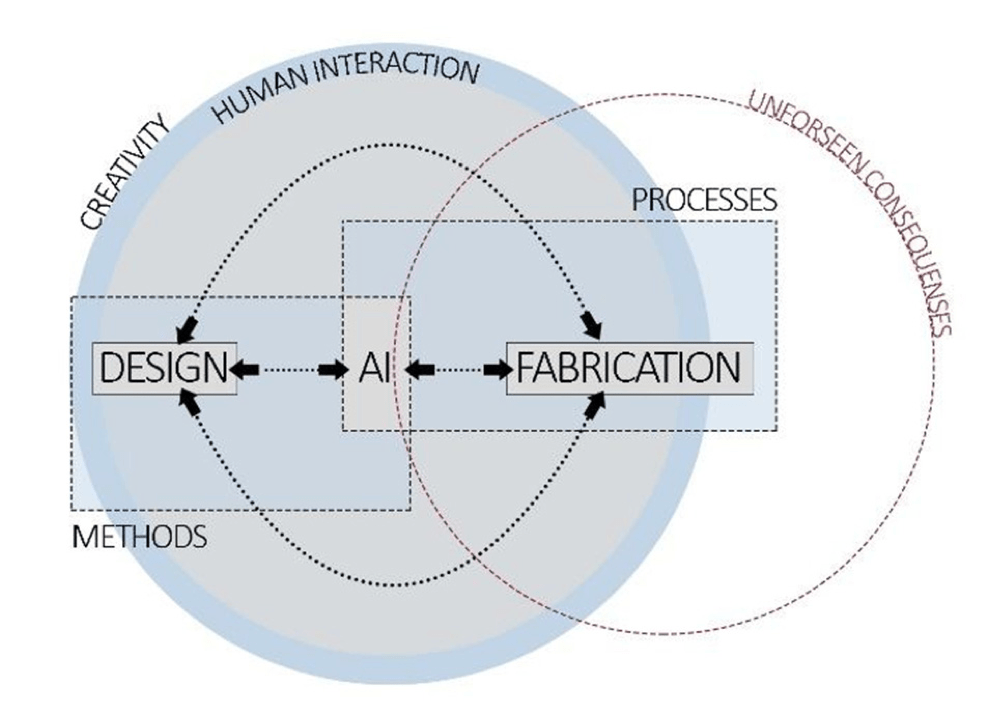
Two readings have stuck out to me this week, both relevant to where I believe my work to be heading. The first is a paper devising an experimental framework on AI and Human co-creation, a particularly salient topic for me. The research involved leveraging ChatGPT assistance to produce a physical artifact called "Rest in Pieces", through a newly devised framework "inspired by the Co-Design
approach used in the architecture, engineering, and construction industries. The framework echoes my process flow that I devised and presented on, and provides a good reference for expanding on it in a non-linear fashion. In an all around inspiring read, they proposed an initial framework, and adjusted it based on their process and work within the project, all framed under their central research question: "How does human-AI collaboration through the Co-Design approach reshape the creative process, particularly in the context of artistic production?". Provided below is the initial framework, followed by their post-production revision.
Both providing an inspiration in visualizing the non-linearity of the process, even just adding the "unforeseen consequences" adds a lot in terms of describing the control one tends to give up when introducing AI.
The second paper is a bit more conceptual, and provides a theoretical framework, a philosophical discussion on the creative abilities of artificial intelligence, and a reflection on the dynamics between the artwork, the art-maker and the art audience. This paper brings up many good points that are top of mind today, such as the authenticity of AI in creating art, what it means to be 'creative' and if AI can be, and an overview of computer generated art up to that point in time. What interested me the most was one of the last chapters, titled "AI-Art as an Autonomous Art Genre". Up to this point, AI as a Co-Creator and AI as a material / medium have been discussed in regards to my thesis, but wrapping it up into a genre as a whole is a very interesting take on it.

To me the notion of labeling it as a genre subverts the idea of AI as a taker of human culture and creative works, and instead acting as an extension of it, while legitimizing it a little more as something to be analyzed with intent. The author sums it up well in this paragraph:

"The evaluation of AI-art is still bound to human emotions and human taste of aesthetics. Nevertheless, it is a different art form which has computational features. It is a genre that combines the human aesthetic, human culture and analog features of the human mind, with the computational system and digital features of machine intelligence."
I wouldn't say this is true of all things generated by an AI to be art, especially considering the pervasiveness of low-quality AI generated videos and images that are ever so prevalent in social media today (AI slop, as netizens have coined). But I would say that in the same vein that any person messing around in photoshop isn't inherently creating art. This is getting more into the philosophical and conceptual ideas of what art is, which this paper also goes into, and while I'm not trying to reinvent the wheel, it's important to consider for this thesis, especially since the definition of AI is something that's come up in discussions around my thesis.
Where the Next Steps are Leading
I have a couple of next steps in line based on what I've read / done so far. On the side of the more bureaucratic and research oriented aspects of my thesis, I will continue to be pursuing the IRB exemption form into the next week. While I still may need a little more time in ironing out how a workshop will look like / be defined in my thesis, at the very least 1/1 practitioner interviews and surveys will fit into the exemptions based on the form provided in the online portal.

In pushing towards more production, and thinking on the idea of "AI as an Autonomous Genre", I think it would be interesting to actually push the AI to be as autonomous and open ended as possible, just to see what it's limits are in true autonomy as far as creative image generation and artistic/compositional integrity. AI can write code creatively, a la p5.js, but what if it creates its own system in its own environment? A new thing that has popped up in the AI world are "Agents" that can communicate with your computer, a notable ability being that it can read and write files directly on your system. You can have more than one running simultaneously, and even have them working tangentially on the same task. Anthropic CEO Dario Amodei equated this potential as "A country of geniuses in a datacenter". I don't think it would produce anything to that level yet, at least not in terms of visual design, but in doing so the goal would be too get a sense of where the human fits in, by seeing what happens with the absence of the human. I've set up the virtual environment where this would take place, what's next is to get the API calls for the agents I'd use, and craft prompts that would let them act as autonomously as they can.
Bibliography
van der Heijden, S. (2023). Artificial intelligence as a co-creator: Exploring AI’s role in the creative process of visual art (Master’s thesis, Radboud University). Radboud University Thesis Repository.

Costa, A. S. L. (2024). Artificial aesthetic: Exploring the convergence of creativity, artificial intelligence, and human expression in art (Master’s dissertation, Instituto Superior de Contabilidade e Administração do Porto, Polytechnic of Porto).
Ryan Schlesinger is a multidisciplinary designer, artist, and researcher.
His skills and experience include, but are not limited to: graphic design, human-computer interaction, creative direction, motion design, videography, video-jockeying, UI/UX, branding, and marketing, DJ-ing and sound design.
This blog serves as a means of documenting his master’s thesis to the world. The thesis is an exploration of AI tools in the space of live performance and installation settings.


 un-prompted
Leave a comment