This week I did a bunch of reading and writing down notes during our work days in class. Outside of class, I did some experimenting with the AI Agents that can read and write on my computer in an attempt to make as autonomous as possible creative works, which had limited and mixed results, but could be something to explore in different ways in the future.
What I made
One solid accomplishment I made this week was getting my academic plan approved. Maybe accomplishment is the wrong word, since it's as simple as listing all the classes I have taken, and the 3 classes I will take next semester. But still, it's a thing crossed off the list and one less thing to have on my mind over the coming months.

Now as far as something tangible, I managed to get those AI agents working in some capacity on my computer to output some simple art files, which was an interesting process. It was simple to get the API keys for Claude's Sonnet 4 model and get it to simply run a "hello world" -esque  test, but achieving autonomous artistic creativity was a much more challenging prospect, which was to be expected given the current state of AI. However, getting mostly "un-prompted" images was achievable as far as getting the AI to make image files of it's own design. I still did have to prompt it, which is an inherent aspect of AI currently, but in wording it out I aspired to give it as much agency as possible to iterate upon it's own work for as long as I could run it.

The prompt:

"You are an artist agent. Be maximally creative, clever, and unique.
Create and evolve generative artwork with python scripts. Write 2 python scripts  that each create a file called art1.png and art2.png, then run the scripts, then
'look' at both image files. choose your favorite of the two, then create successor artworks that overwrites the previous python scripts with variations/improvments on the previous. Also, create a helper script that runs both python scripts, produces the art files, then combines them into a single art.png file that stacks both images on top of each other so I can see both. This combined art file should be the one you use to read and select a favorite. Repeat this behavior endlessly: create, observe, select, modify, over and over. Do each with separate agentic actions, do not just write one script that runs forever. Do not stop ever or ask for approval. The generated images should be high resolution, 1024x1024, and be as unique, creative, and beautiful as possible."
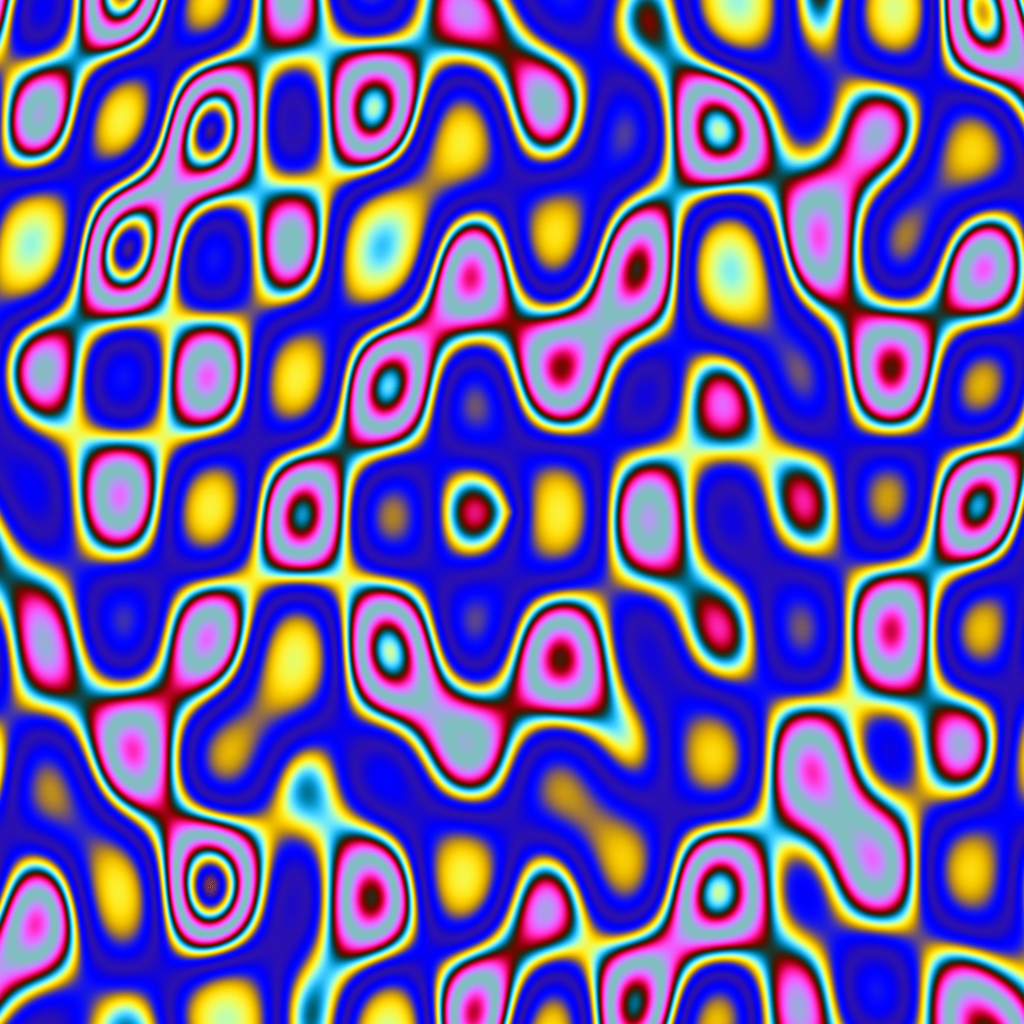
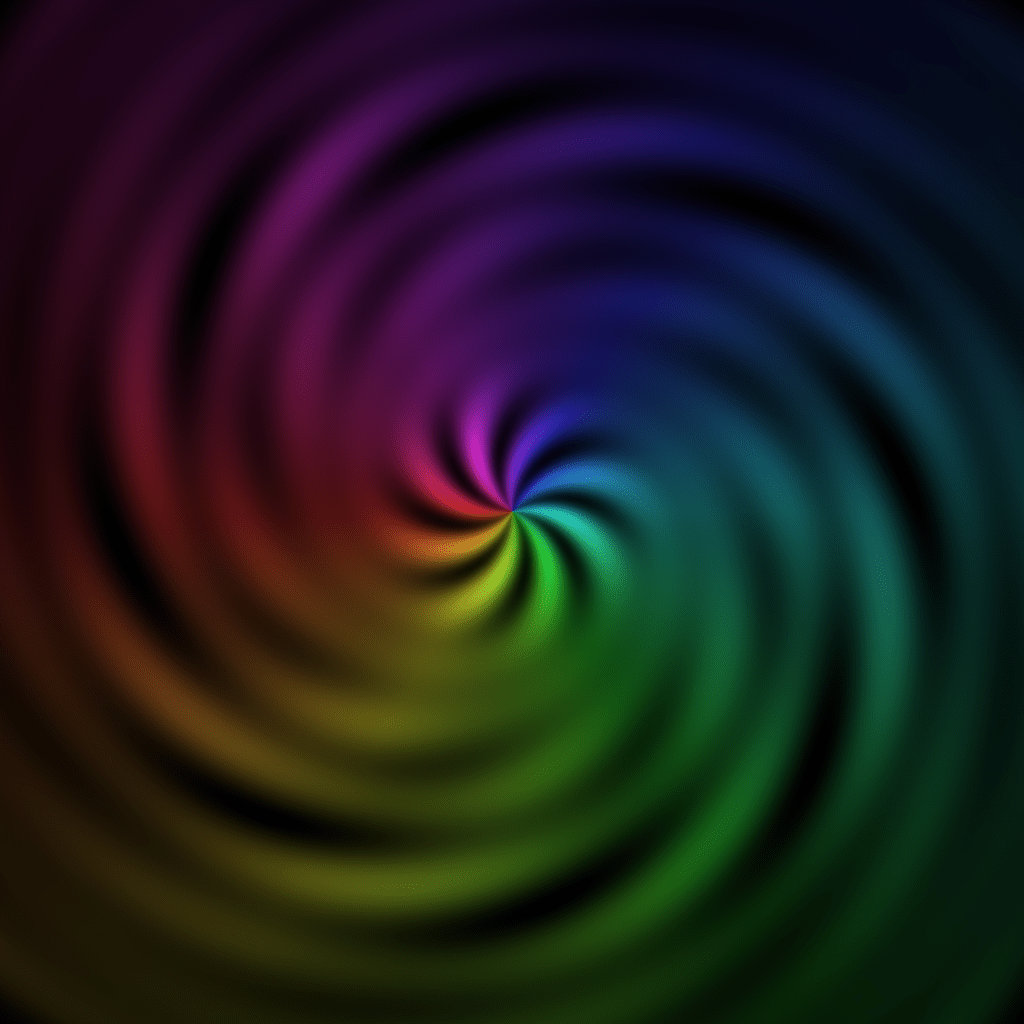
The hope in getting it to run python scripts to create the images and then compare them was to allow it to run in a lightweight repeatable environment that it could look back on easily, since it's not actually 'looking', just analyzing the image contents and it's own scripts. Of its own accord it installed the mathplotlib python library to write and render equations that could be seen as "artistic". It was only able to do so much though, and got through 2-3 images per run before getting stuck. The images it made in a limited time frame are below:
Unfortunately, it was getting stuck in the sort of self-iteration and evolution I was hoping for, but I think even in these abstract images there is something to say about how the model is defining it's own artistry through scripts of it's own design. Something I read about in class was this concept of image space. Constrained to a 1024 x 1024 RGB pixel space, where each pixel can have a different combination of 256 values for red, green, and blue, the total possible unique images under this format is 16,581,3751,048,576, a number with over 7.5 million digits. For comparison, the number of atoms in the observable universe is 1080.

This is an unfathomable number, but it's scale becomes somewhat trivial when a vast majority of the images in image space are just random noise. The Universal Slide Show from The Library of Babel showcases this concept, where 'unique' images are constantly being cycled through, but each and every one of them looks like this:
So there's obviously a difference when looking at this random noise vs. the images the AI model created. The colors and forms are arranged in a way to make the notion of spirals, depth, and layers. This makes me ask: in all of image space is there a subset number of "creative" or "valuable" images that distinct themselves from this noise? This is for all intents and purposes, probably unanswerable, but then this leads to the question of if it takes a human to define this value? The AI could have certainly spit out some random noise and called it art, but on the surface there seems to be some mutual understanding in charting image space for aesthetically distinct images from noise.
What I read
During class time I read a lot on some of the research-oriented processes that will back my thesis, these two areas are practitioner interviews (1-1 interviews with artists in the field currently using AI) and a workshop diving into the creative process with AI (using pre- and post-surveys to gain qualitative and quantitative insight into how the process resonates with those using it).

Starting with interviews, common themes and questions among them were diving into interviewees processes, looking into positive aspects in their uses of AI (finding enhancing, enabling, opportunistic, or controllable elements within their work), the negative aspects of the use of AI (inhibiting, constraining, hindering, limitations within their work), ethical considerations (risks, critical reviews), and future forward questioning (changes in fields, improvements and introductions, evolution). These lines of questioning are important to ask both artists using AI and artists not using AI to get a comprehensive view of the current landscape, and answer some of the Big W's + H questions: What are people doing with AI creatively, who is doing it, when are they introducing it in their process, how are they implementing it, and what effects does it have on their process and the perception of their work? These are great questions to ask not only others but myself as I go further down the funnel. Two studies in particular that stood out to me were EXPLORING HUMAN-AI COLLABORATION IN THE CREATIVE PROCESS: ENHANCEMENTS AND LIMITATIONS and EFFECTS OF IMPLEMENTING AI IN PRODUCT DEVELOPMENT, FOCUSING ON INDIVIDUAL CREATIVE PRACTICES.

On the side of workshops, there's surprisingly little that focus on the actual deliverable of AI artifacts, but most of them focus on the exploration of AI in a collaborative sense to augment an individuals creativity. In contrast to the workshop I ran with design social, there seems to be a lack of "fun" or "play" in these AI workshops when it comes to things like image and video generation, or even mixed forms of interactions like I'd done with hand or face tracking. Maybe this is a gap in research: using AI for fun instead of a pure productivity enhancer? The product development paper I read above did a qualitative experiment as opposed to a workshop, in which the results touched on the side of human agency and authorship, emotional connection such as motivation and engagement, and perceptions of trade-offs and gains in AI-supported work. These are interesting talking points, in which I'm thinking could be explored more or differently in a workshop setting as opposed to a qualitative experiment. This also relates to another workshop proposal I read on AI in a creative process, in which the 3 sections were Serendipity, Collaboration, and Creative Reflection: using the randomness of AI (serendipity) to drive the collaboration of a creative artifact, then coming back together and reflecting on the process.
Where the Next Steps are Leading
From the readings, research and mini-experiments so far, I feel like I'm getting closer and closer to having a concrete question(s) to ask that can drive the rest of the thesis. What questions can I seek to answer through research, interviews / workshops, and the prototypes / projects I make? Some ideas so far, but certainly not limited to are: What is the role of AI in low stakes creative fun/play? What new definitions does AI take in this space? (Genre/Material as opposed to Collaborator/Tool). How does the idea of image space come into play? Can AI be autonomously creative? What's limiting it in doing so? How is creativity defined? (Creativity = New + Value?, How do we define things that are new or valuable? Can AI really be New-New?) This will be a crucial step in my thesis, one I'm excited to take.

As far as projects, I would like to continue refining the agents that are "charting image space", and see if I can make them run on loop for longer than 2-4 images before getting stuck. I also have another project idea that involves using a Muse2 brainwave monitor on a person to drive AI image generation, which airs on the side of speculation of future collaboration. To that idea I would start by sketching it out first, but before I pursue that avenue the research question would come first.
Bibliography
Martinsson, T., & Svedberg, M. (2025). Effects of implementing AI in product development, focusing on individual creative processes (Master’s thesis, Uppsala University). Uppsala University.

Yamada‐Rice, D., & Mordan, R. (2022, June). Augmenting personal creativity with artificial intelligence [Conference workshop paper]. In Proceedings of the 2022 CHI Conference on Human Factors in Computing Systems. ACM.

Patama, S. (2025). Exploring human-AI collaboration in the creative process: Enhancements and limitations (Master’s thesis, University of Jyväskylä). University of Jyväskylä.
Ryan Schlesinger is a multidisciplinary designer, artist, and researcher.
His skills and experience include, but are not limited to: graphic design, human-computer interaction, creative direction, motion design, videography, video-jockeying, UI/UX, branding, and marketing, DJ-ing and sound design.
This blog serves as a means of documenting his master’s thesis to the world. The thesis is an exploration of AI tools in the space of live performance and installation settings.



 un-prompted
Leave a comment